
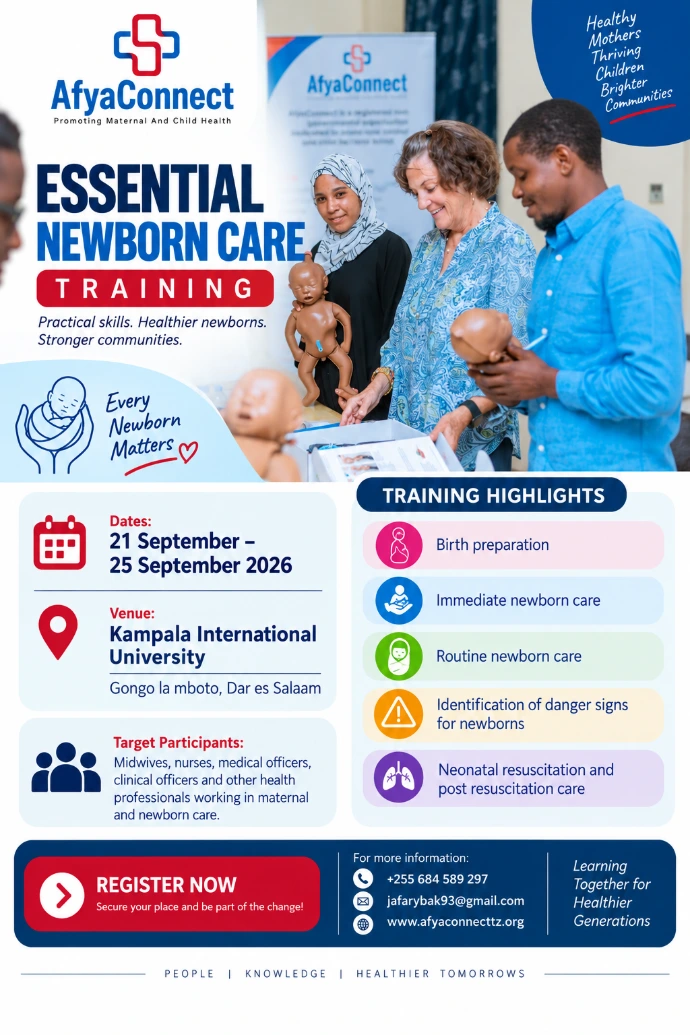
Every Newborn Matters: Building Life-Saving Skills Through Essential Newborn Care Training 2026
Start writing
A Safe Beginning, A Healthier Future
The first moments of a newborn’s life are among the most critical moments in the journey of life. The quality of care provided immediately before, during, and after birth can make a profound difference in a newborn’s survival, health, and development.
Every newborn deserves to be welcomed into the world with skilled, timely, and compassionate care.
Recognizing the importance of strengthening newborn care skills among healthcare professionals, AfyaConnect is organizing a five-day Essential Newborn Care Training from 21st to 25th September 2026 at Kampala International University, Gongo la Mboto, Dar es Salaam, Tanzania.
The training is designed to strengthen practical knowledge and skills among healthcare professionals who are involved in maternal and newborn care, with a strong emphasis on hands-on learning, clinical decision-making, teamwork, and the timely recognition and management of newborn complications.
Why Essential Newborn Care Matters
The transition from life inside the womb to breathing independently outside the womb is a major physiological change for every newborn.
Most newborns make this transition successfully with appropriate routine care. However, some babies may require additional support immediately after birth, while others may develop complications during the early neonatal period.
This means that healthcare workers need to be prepared to:
Prepare effectively for every birth.
Provide immediate and essential care after birth.
Maintain newborn warmth.
Support early and appropriate feeding.
Assess the newborn systematically.
Recognize danger signs early.
Initiate appropriate interventions without unnecessary delay.
Provide effective neonatal resuscitation when required.
Continue appropriate care after resuscitation.
Communicate effectively with parents and caregivers.
Having the right knowledge is important, but being able to apply that knowledge confidently and correctly in a real clinical situation is equally important.
This is why practical skills development is at the heart of the AfyaConnect Essential Newborn Care Training.
What Will Participants Learn?
The five-day training will focus on key areas of newborn care that healthcare professionals encounter in everyday clinical practice.
1. Birth Preparation
Effective newborn care begins before the baby is born.
Participants will explore how effective preparation for birth can help healthcare teams anticipate potential complications and ensure that the necessary personnel, equipment, supplies, and environment are ready.
The session will emphasize the importance of:
Preparing the birth environment.
Ensuring essential equipment and supplies are available.
Preparing for both normal and complicated births.
Assigning roles within the healthcare team.
Anticipating newborn resuscitation needs.
Effective communication and teamwork.
Maintaining infection prevention and control practices.
The goal is to help healthcare workers develop a “prepared for every birth” mindset.
2. Immediate Newborn Care
The period immediately following birth is critical.
Participants will strengthen their understanding and practical skills in providing appropriate immediate care to newborns, including assessment of the newborn and supporting a smooth transition to extrauterine life.
Key areas will include:
Immediate assessment of the newborn.
Appropriate drying and stimulation.
Prevention of heat loss.
Skin-to-skin care where appropriate.
Support for early breastfeeding.
Umbilical cord care.
Assessment of breathing.
Identification of newborns who require additional support.
Appropriate documentation and communication.
Participants will also discuss how seemingly simple interventions can have an important impact on newborn health and survival.
3. Routine Newborn Care
Essential newborn care does not end after the first few minutes of life.
Newborns require continued observation, assessment, protection, feeding support, and appropriate preventive care.
The training will address important components of routine newborn care, including:
Ongoing assessment of the newborn.
Maintaining normal body temperature.
Breastfeeding support.
Infection prevention.
Safe cord care.
Monitoring feeding and elimination.
Identification of abnormalities.
Newborn examination.
Appropriate newborn documentation.
Communication with mothers and caregivers.
The emphasis will be on providing respectful, safe, evidence-informed and family-centred newborn care.
4. Identification of Danger Signs in Newborns
Early recognition of newborn danger signs can be critical.
A newborn who appears stable can deteriorate rapidly when serious illness develops. Healthcare professionals therefore need to recognize abnormal signs promptly and understand when urgent assessment, treatment, referral, or escalation of care is required.
Participants will strengthen their ability to identify important newborn danger signs and respond appropriately.
The session will encourage participants to think critically:
What do I see?
What does it mean?
What could be causing it?
What should I do next?
Does this baby need urgent intervention or referral?
This approach is intended to strengthen clinical reasoning rather than relying only on memorized lists.
5. Neonatal Resuscitation and Post-Resuscitation Care
One of the most important components of the training will be neonatal resuscitation.
When a newborn does not establish effective breathing after birth, every moment matters. Healthcare workers must be able to rapidly assess the newborn, identify the need for intervention, initiate appropriate resuscitation steps, and work effectively as a team.
Participants will have opportunities to develop and practice skills related to:
Initial newborn assessment.
Recognition of ineffective breathing.
Effective ventilation.
Use of neonatal resuscitation equipment.
Team communication.
Appropriate escalation of care.
Assessment of response to interventions.
Decision-making during resuscitation.
Documentation of resuscitation.
Post-resuscitation monitoring and care.
Through practical scenarios and simulation-based learning, participants will be encouraged to think, assess, act, reassess, and communicate.
The focus will not only be on performing individual procedures, but also on developing the teamwork and clinical judgement required during emergencies.
From Knowledge to Practical Skills
A major feature of the Essential Newborn Care Training will be the integration of theory with practical learning.
Participants will have opportunities to engage in:
Interactive Learning
Facilitated discussions will allow participants to connect evidence-based knowledge with their own clinical experiences.
Skills Practice
Participants will practice essential newborn care and resuscitation skills using appropriate training equipment and simulation.
Case-Based Learning
Realistic clinical scenarios will challenge participants to analyze information, identify problems, prioritize actions, and make appropriate decisions.
Team-Based Simulation
Participants will practice working together during newborn emergencies, with emphasis on communication, role allocation, leadership, and timely intervention.
Reflection and Feedback
Facilitators will provide constructive feedback to help participants identify strengths, address gaps, and improve their clinical performance.
Who Should Attend?
The training is particularly relevant to healthcare professionals involved in maternal and newborn care, including:
Midwives
Nurses
Medical doctors
Medical officers
Clinical officers
Neonatal and newborn care providers
Maternal and child health professionals
Other healthcare professionals involved in childbirth and newborn care
The course is also relevant for professionals who have responsibility for training, mentorship, supervision, quality improvement, and clinical skills development in maternal and newborn health.
Why Attend?
Participants will have the opportunity to strengthen both their knowledge and practical competencies in essential newborn care.
By the end of the training, participants will be better prepared to:
Prepare → Assess → Identify → Act → Reassess → Continue Care
The training will help participants strengthen their confidence in responding to routine newborn needs as well as situations that require urgent intervention.
Most importantly, the training aims to contribute to a culture where every newborn receives safe, respectful, timely, and skilled care.
Training Details
Essential Newborn Care Training 2026
Organized by:
AfyaConnect
Dates:
21st – 25th September 2026
Venue:
Kampala International University
Gongo la Mboto, Dar es Salaam, Tanzania
Duration:
Five Days
Training Highlights
Birth Preparation
Immediate Newborn Care
Routine Newborn Care
Identification of Danger Signs for Newborns
Neonatal Resuscitation and Post-Resuscitation Care
About AfyaConnect
AfyaConnect is an organization committed to promoting maternal and child health through knowledge, skills development, collaboration, and practical solutions.
The organization works to strengthen the capacity of healthcare professionals and communities to contribute to improved maternal, newborn, and child health outcomes.
Through training and professional development, AfyaConnect seeks to connect people, knowledge, and practical skills to create healthier communities.